Leonard
The Other Black GirlLeonard is Wagner Books’ veteran head of design, an award-winning cover designer who has worked there for nearly four decades. The novel presents him as both a source of institutional expertise and a conspicuously unhappy presence in the office: his career is marked by creative accomplishments, but the meetings in which he displays that expertise also show how withdrawn and worn down he seems.
Identity and Standing
Leonard has led Wagner Books’ design department for almost forty years and has received numerous awards for innovative covers, including designs for books that became classics. His seniority and achievements make him part of the publisher’s old guard. Yet his status does not translate into visible ease or authority in every interaction: during one meeting he says little, remains hunched over his notepad, and appears burdened by the work.
Nella studies his office appearance in detail: an unassuming checkered shirt, a golf pencil behind his ear, and gray hair that would grow in patches if he did not shave his head regularly. His head is almost always bowed. She estimates that he earns at least three times her salary and suspects he has no children, but these are Nella’s impressions, not confirmed facts. Looking at the contrast between his long tenure and apparent misery, she wonders why he does not retire and whether he is simply holding on until he can no longer do so.
Demeanor in the Office
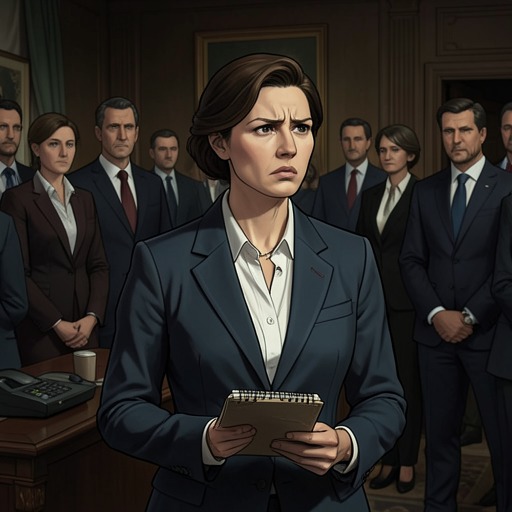
At a meeting, Leonard sits hunched over a notepad, covering half his face with one hand and gripping a golf pencil with the other. When Nella takes the only available seat near the discussion and tries to make friendly conversation, he looks up with bloodshot eyes and responds sharply that the place is running him into the ground, as usual. The exchange gives his unhappiness a direct voice: it is not only Nella’s reading of his posture, but something he articulates himself.
The narration also suggests that his dour public manner may not encompass his entire character. Nella sees him as carrying very few smiles at work, and imagines that he keeps most of them for the private space of his office, with the door closed and his creative work underway. That possibility remains her speculation, but it complicates the impression of Leonard as simply surly: the office may be where his exhaustion is most visible, rather than the only measure of him.
The Needles and Pins Cover Meeting
When the discussion turns to the cover for Needles and Pins, Leonard produces three glossy proposals from a manila folder that has been resting in his lap. He places the pages on the table and turns them toward Vera, angling them slightly toward Richard. His presentation is measured and physical: he stands, sways slightly as he speaks, and explains how the options relate to the author’s existing book designs.
Leonard describes the first two approaches as continuing the visual language of the author’s recent books: minimalism, striking color contrasts, and sans-serif type. He says that maintaining the branding established in 2011 could appeal to readers who expect a familiar look and to those who like their books to appear as a set. One proposed treatment pairs melon-red words with a black background. Nella privately thinks the words should have been chartreuse, a small contrast between Leonard’s professional design rationale and her own sharp, unspoken preference. The meeting establishes the specifics of the first two concepts; the available account does not describe the third proposal.
Before Leonard presents, he has remained silent after being asked about a rescheduled cover meeting. Vera then invites him to show his work and gives him a forceful wink, an apparent peace offering after the Sam Lewis dispute. Nella finds the gesture unnatural, but notices that Leonard’s hunch eases slightly. The moment registers a subtle shift in his posture rather than a clear reconciliation: he responds to the opening by bringing out his designs and continuing with the meeting.
Characterization and Narrative Role
Leonard’s scenes place accumulated experience beside present-day strain. His awards and decades of leadership establish him as a skilled designer; his bowed head, sparse smiles, bloodshot eyes, and complaint about being run into the ground show the cost or burden that Nella perceives in his continued office life. The novel does not supply a definitive explanation for his unhappiness or his decision to remain at Wagner Books, leaving Nella’s questions unresolved.
In the cover meeting, his work is also a concrete example of how design decisions draw on both creative judgment and commercial continuity. Leonard’s proposals consider the author’s established branding and the expectations of readers who recognize a recurring look, while Nella’s silent chartreuse alternative marks her distinct response to the same visual problem. Leonard thus appears not as an abstract representative of the old guard, but as a working designer whose expertise is visible in the details he presents and whose dissatisfaction is visible in the way he occupies the room.